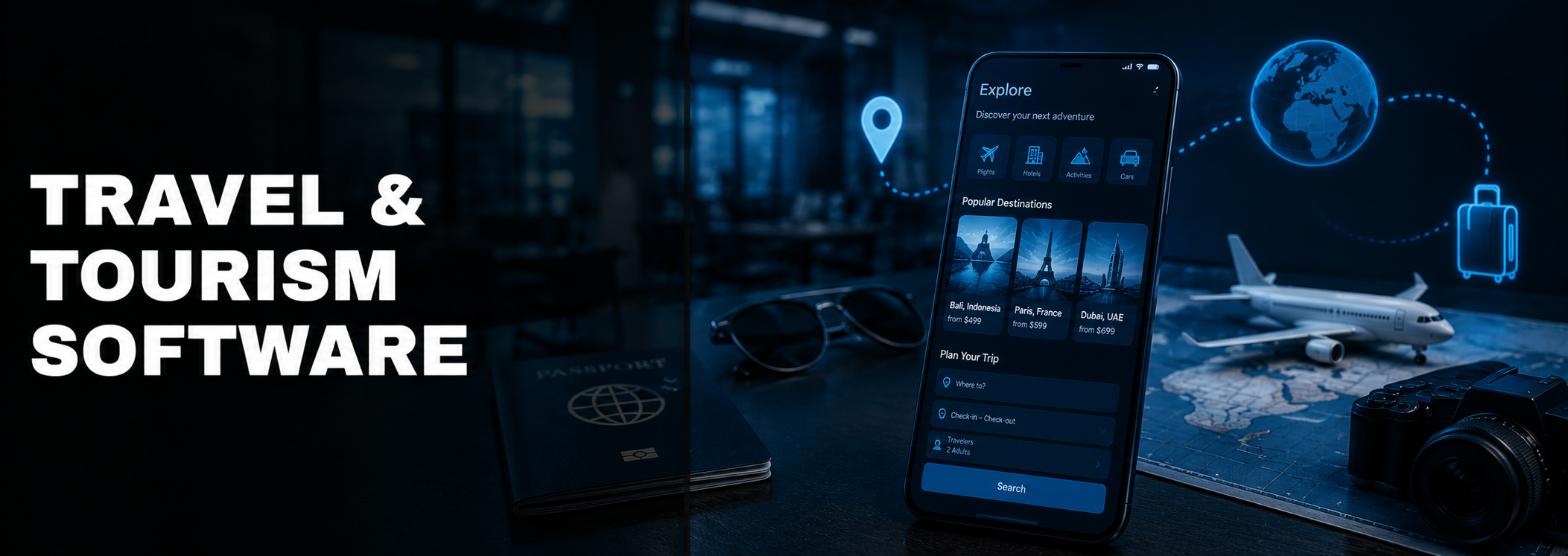
The Rise of Travel & Tourism Software: Making Bookings Easier Than Ever
When it came to taking a trip, the past few years have seen the elimination of phone calls, communication via emails, manual confirmation, and a lot of waiting. It wasn't much simpler for travel companies either. Each agent would have to process reservations manually, update availability information on various channels, and process customer inquiries manually. It was effective at first, but when customer expectations shifted.
Today's traveler doesn't want to wait. They're interested in comparing places, confirming availability, making reservations, paying with security, and confirmation within minutes, often using their smartphones. If there seems to be a slow or convoluted booking process, they'll probably leave and go to a competitor. It has changed the way that consumers are traveling, and this has sent a strong message to the travel industry about how it needs to work.
That's where the travel software development has proved to be a game-changer. For modern travel and tourism software, it becomes important to understand how it can help businesses streamline their processes and boost overall efficiency in customer booking and experience. Companies that are adopting these tools are getting creative in how they use them to streamline business processes, enhance customer satisfaction, and remain competitive in the rapidly spiraling market.
Why the Travel Industry Could No Longer Rely on Traditional Processes
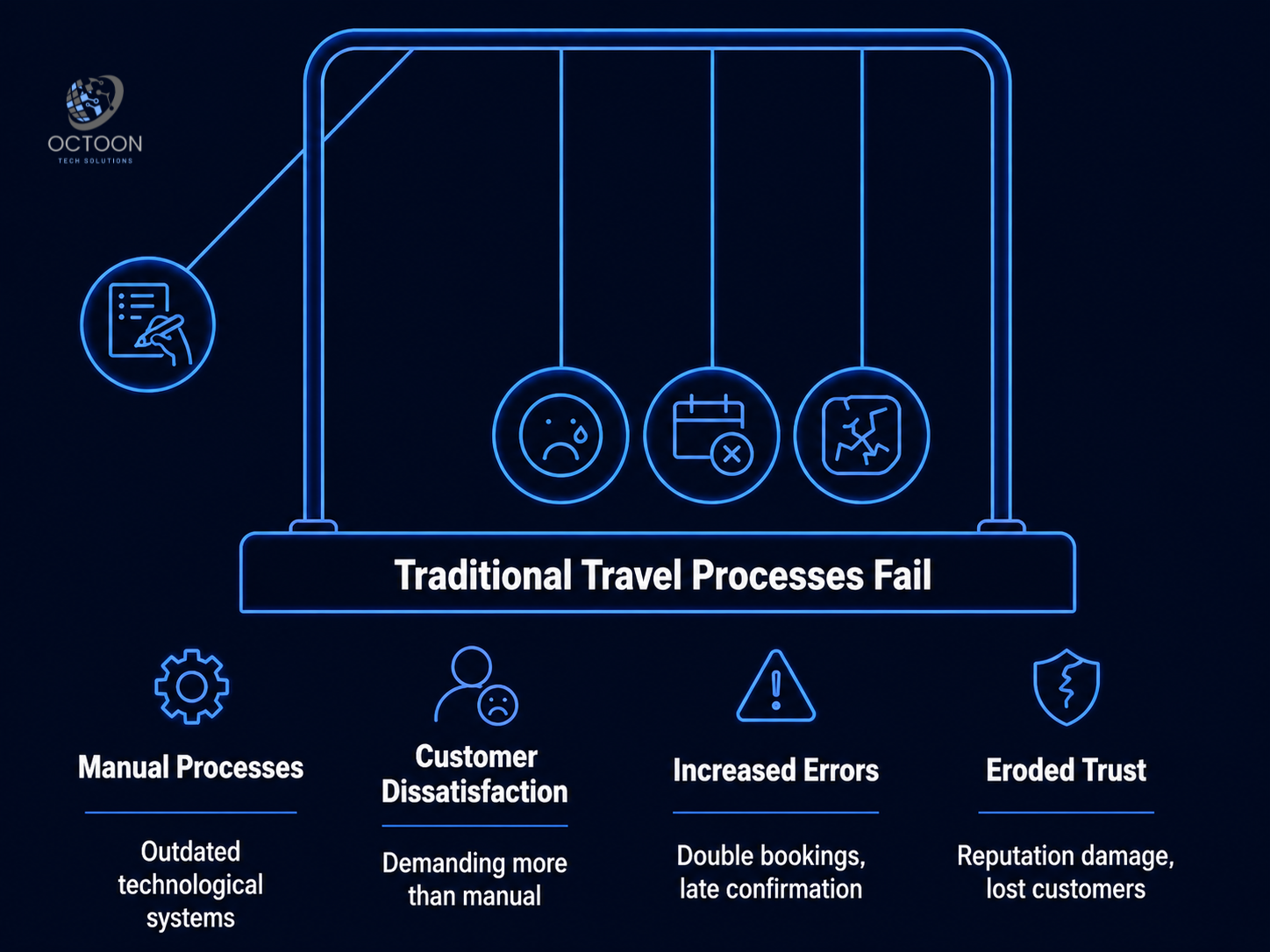
From the beginning, traveling has been a human activity. Relationships, recommendations, and customised service are key. However, customers have begun to demand more than manual operations can provide.
A vacationer today might have used 10 vacation sites, customized booking methods, and read several reviews before settling on a booking in one night. There are simply too many businesses that have outgrown their technological systems and are unable to withstand such pressure.
It's not just a timing test. It's also a matter of accuracy.
Manual bookings have an increased risk of error. These issues, such as double bookings, late confirmation, wrong pricing, and poor communication, can all erode customer trust in a short amount of time. Reputation is a critical issue in any service and hospitality company, and small errors in their operations can add up to cost.
It's no surprise that software solutions have emerged, not as the solution for the removal of human service, but rather as a solution to stop the friction businesses can't afford, delivering great service consistently.
The Shift Toward Travel SaaS Solutions
The massive growth of travel SaaS solutions is one of the most significant developments of the past few years.
Rather than buying expensive hardware and software, companies can deploy solutions in the cloud, which offer them booking management, customer relationship (CRM), reporting, and automation tools in a single place.
This transformation has made it easier for businesses to initiate.
Small businesses can now leverage what previously was a capability of large businesses. Meanwhile, scalability, real-time data access, and third-party integrations make larger travel companies that much easier to use.
Flexibility also allows for the increasing adoption of travel SaaS solutions. Every travel company is in a constantly changing environment. Changes in demand and legislation are always present and must be accommodated quickly without causing too many impacts.
This is possible with cloud-based solutions.
How Tour Booking Software Is Transforming the Customer Experience
The challenge for the operators of the tours is special.
While they are not like standard travel booking, tours can have more than one schedule, have spaces that change, cost may differ, and there can be other logistical factors involved. It can be easy to lose track of these shifting components if done manually.
Tour booking software can prove to be valuable because it enables customers to:
- Check live availability.
- Select preferred dates.
- Make online payments.
- Receive instant confirmations.
Internally, the software manages everything from scheduling to capacity and reservation management, all without the customer even noticing
The perks are not just convenient for business owners, however.
Automating the booking process, it saves administrative staff time, helps ensure accuracy, and allows them to concentrate on customer service and business development. Teams can focus on providing meaningful travel experiences, no longer worrying over hours spent booking.
The outcome is a streamlined performance and delightful customer experience throughout.
Why Hotel Booking Software Has Become Essential
This shift has also taken place in the hospitality industry.
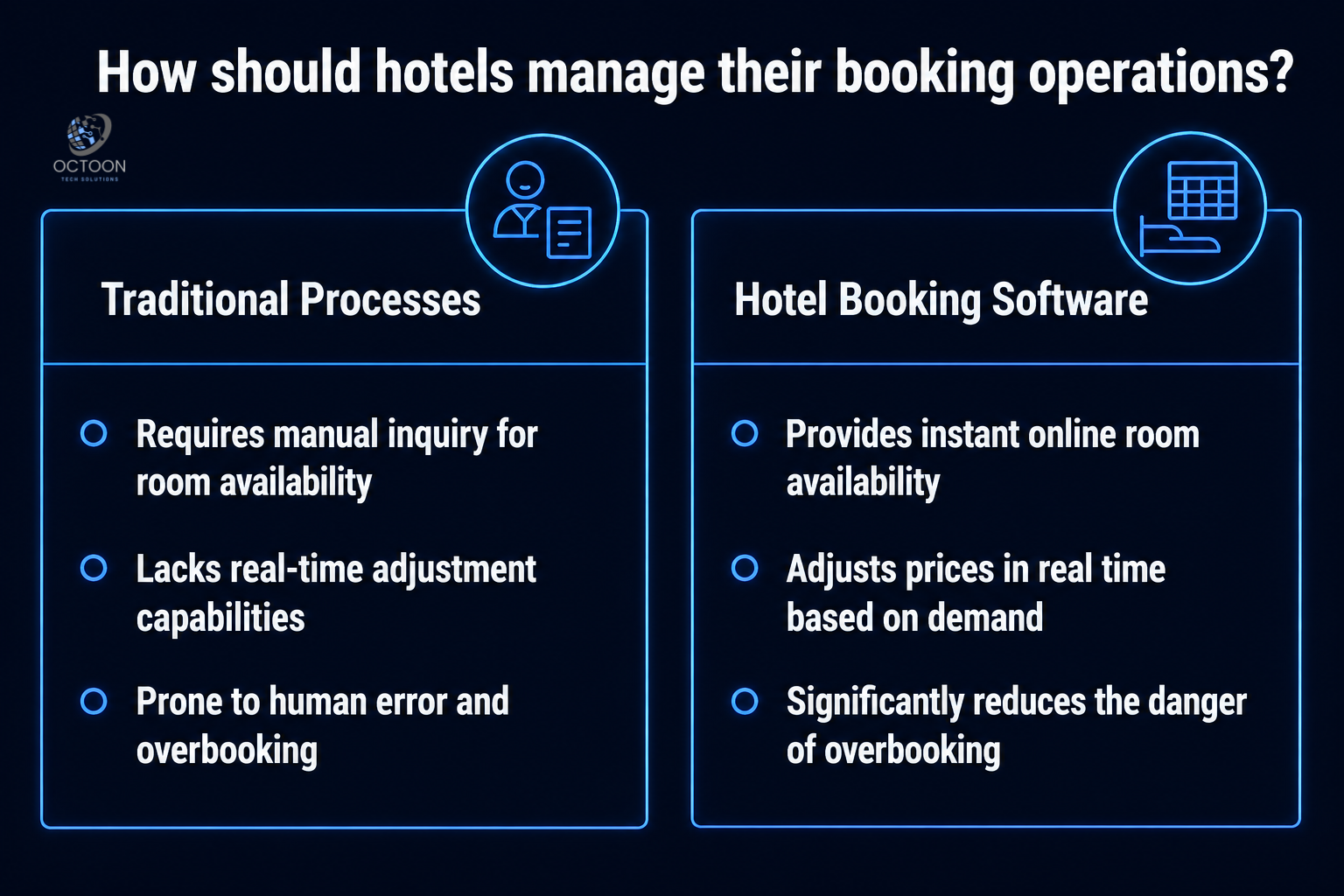
No longer will they have to ask the question, "When is it available? No longer do they have to ask, "When is it available? They want answers now!
Being capable of providing online room availability, secure payments, automated confirmations, and managing rooms in a single system, Hotel booking software helps hotels, resorts, and accommodation providers to improve their business.
Such automation brings a better guest or employee experience.
In the event that systems are linked to stock management, the danger of overbooking is significantly reduced. The price can also be adjusted in real time according to the demand, ensuring that the business maximises the occupancy and revenue.
Software serves as a unified source of information for hotels functioning through different channels. If not managed properly, the growing number of bookings will complicate room management.
The Hidden Cost of Inefficient Booking Systems
There are still plenty of travel agency brands that are making use of antique instruments as they seem less costly in the very short run.
It's the cost of inefficiency which is what often goes unnoticed.
The longer the booking process takes, the more likely it is for customers to abandon bookings. Hand-entries may cause scheduling inaccuracies. Time delays can push prospective customers over to another competitor.
These trivia answers start to accumulate over time.
The losses of bookings, operational inefficiencies, and more administrative workload directly affect profitability. Keeping an outdated system and its resulting problems and lags often isn't intuitively obvious, but it can make a big difference to the business.
A modern travel software system can help alleviate these bottlenecks by providing faster, more reliable working procedures to support growth rather than hinder it.
Why Travel Software Development Is Becoming a Strategic Investment
Travel Software Development is essentially becoming a strategic investment due to the number of factors it offers. Several factors have made travel software development a strategic investment.
There are lots of travel companies that start off using an off-the-shelf platform, and for some, it does.
But, as appearances may deceive, growth may also be confined.
As businesses get more complex, they need to have workflows, but they need them to be specialized in certain ways, need an experience when booking, need integrations that are unique, and need to be able to report in certain ways, which generic platforms may not be designed for.
That's where the software development aspect of your travels is an investment instead of an expense.
Businesses can create systems based on their processes, rather than software, with custom solutions.
The needs of a tour company with available adventure experiences are different from the requirements of a luxury travel agency. Likewise, a national hotel with its own challenges will not be the same as an international bookings site.
Custom software recognizes these distinctions and offers the flexibility offered by many standardized platforms.
When Does a Business Need Custom Travel App Development?
Not all companies need a custom solution right away.
But there are certain indicators that give out that it's time to get started with app development for travel.
Companies may end up with a bunch of standalone systems to perform their operations. Others find that integrations are difficult, or the degree of customization is not sufficient, or the requirements of clients are constantly increasing, and the current tools can no longer satisfy them.
The other main factor is the behavior of the mobile.
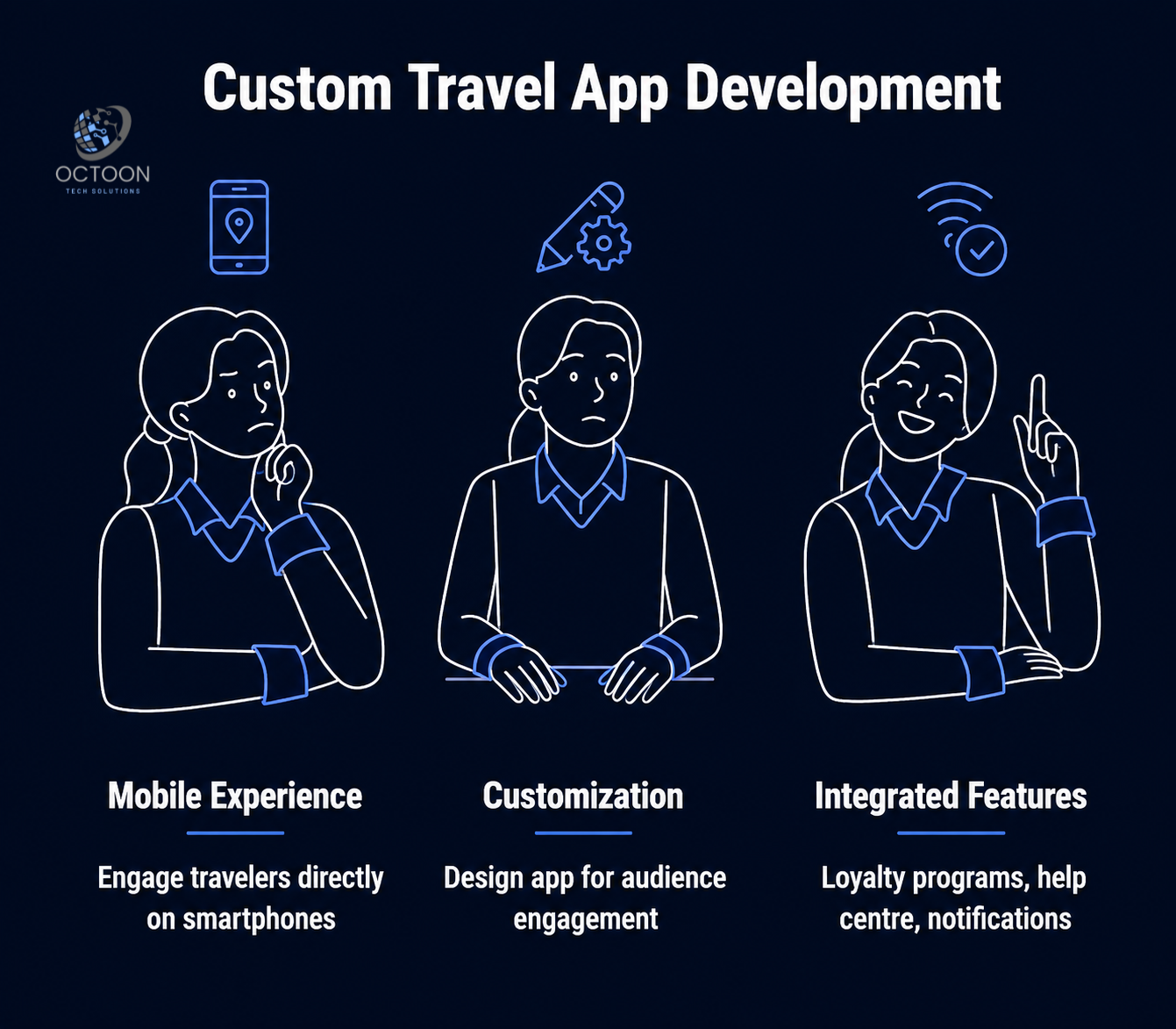
It has become common for travelers to go on the internet to find, compare, and make travel bookings directly from their smartphones. If businesses don't create the right mobile experience, they risk missing out on customers even before they can make a booking.
With custom travel apps, businesses can design their mobile application to engage their audience seamlessly. Customization, travel plans, help centre, loyalty programs, and notifications all these can contribute to an increased engagement and retention rate.
In today's digital age, mobile platforms can be the actual source of income in your business, especially for growing enterprises.
The Growing Importance of Personalization
Two travelers coming to the same place can have opposite expectations and preferences.
Working with the customer data, modern software helps companies go beyond a one-size-fits-all recommendation and provide tailored experiences.
Don't apply the same tips to a family planning a vacation as you would to a solo backpacker. Someone who travels for work will have a different set of requirements than someone who wants to go on a honeymoon.
Delivering relevant recommendations: Better Customer Satisfaction, Higher conversion rate.
Personalization isn't a nicety anymore.
Slowly, it is becoming commonplace.
Without engaging in meaningful experiences, businesses might not be able to keep up with the competition when platforms know how to engage others better.
How Corporate Travel Is Becoming More Efficient
Soft technology has an effect bigger than just holidays.
Vacations are also a problem for businesses that feature remote or hybrid work arrangements.
Approval processes, expense tracking, compliance with policies and procedures, and expense management tracking can be challenging with manual tracking of travel costs.
This is where a travel management system can be most beneficial.
These platforms act as one place for travel planning, approvals, travel reporting and policy enforcement.
The employees have a better booking experience and the organisations more visibility and control.
This brings in easier administration and effective accounting.
The importance of travel and expense management software.The need of travel and expense management software.
Travel costs can be a source of frustration for staff and HR departments.
Receipts get misplaced. Claims for reimbursement are put on hold. Manual reporting can be time-consuming.
Why Travel and Expense Management Software Matters
Expense management software can solve these issues by automating the expense entry, reporting, and approval process.
Expenses can be recorded electronically by employees, and finance departments have access to reporting and instant visibility of their expenses.
This degree of automation ensures the accuracy of information while minimizing the administration involved.
What's most important is that it helps organizations realize which areas to focus on and optimize travel expenditure without sacrificing the employee's experience.
The Role of Data in Modern Travel Operations
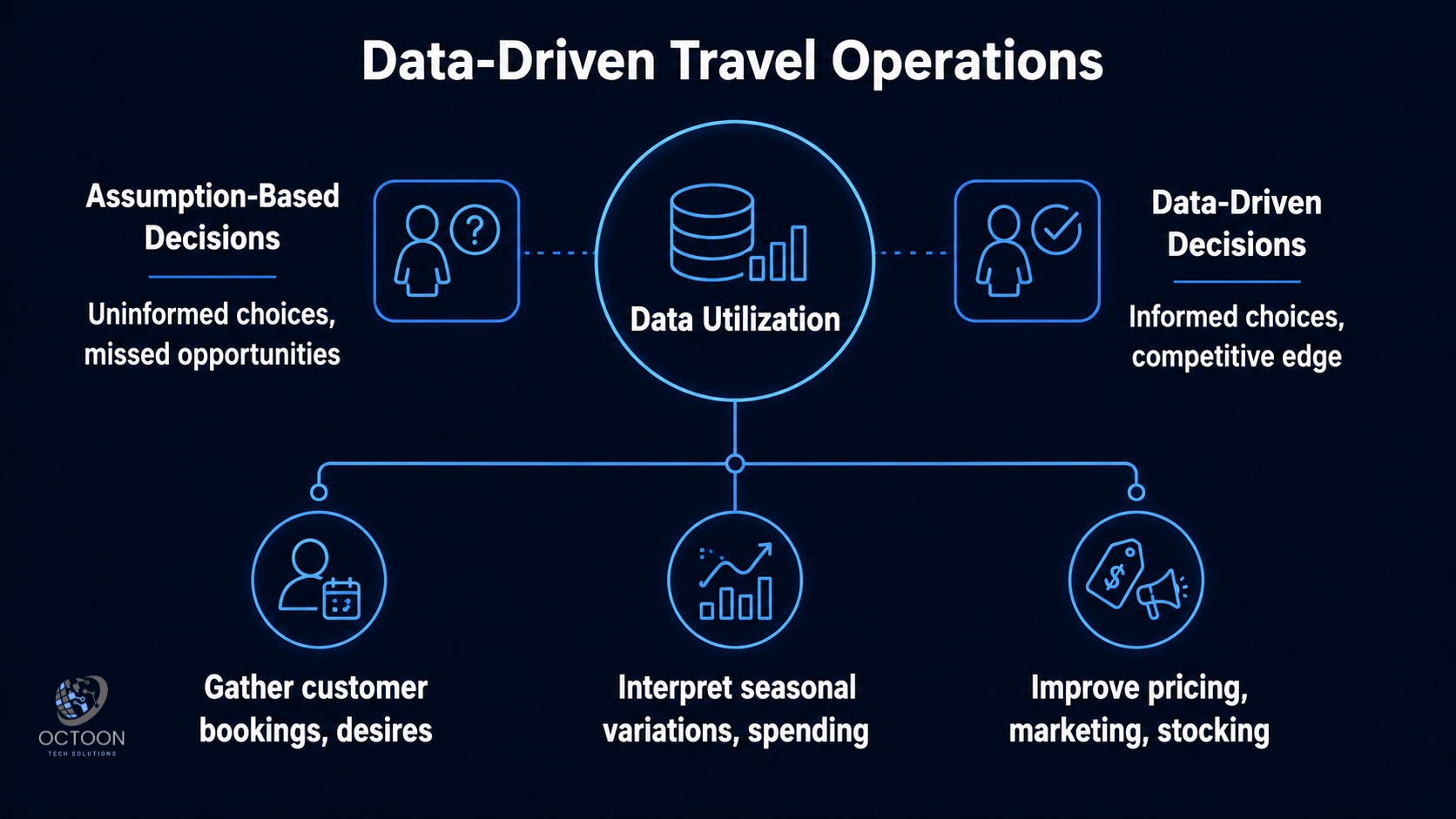
If there is one thing that underpins each of the successful travel platforms, it is data.
Customer bookings, customer future desires, seasonal variations, cancellation rates, and spending habits are all informative.
Companies that do this right will make better choices on pricing strategies, marketing, stocking policies, and customer engagement.
Use of data for decision-making is a key competitive edge.
Travel companies shouldn't make assumptions; they can uncover opportunities and obstacles through actual users' actions.
Those organizations that are successful now tend to flourish on the back of their customer service and savvy data interpretation.
Looking Ahead: AI and the Future of Travel Technology
The tourism industry is starting to be affected by the powers of AI automation.
Features like AI-driven chat support systems, custom-made suggestions, predictive pricing algorithms, and intelligent trip planning are becoming more widespread.
The objective isn't to take the place of human contact.
AI, on the other hand, enables businesses to respond quickly, customize interactions effectively, and meet the rising expectations of their customers.
Travelers are expecting more than just reacting to requests; they're expecting you to anticipate their needs.
If companies can effectively adopt these innovations, they stand a good chance of being the top dogs in their industry in the days to come.
Convenience, personalization, and intelligent automation will characterize the future of travel technology. Octoon Tech can support this evolution by offering bespoke software development services for travel management.
Conclusion
Convenience is a key factor in today's successful travel business. Customers want things done quickly, easily, and with a mobile-friendly service that provides them with personalized recommendations. If your businesses are based on old systems, it's difficult to keep up with these rising customer expectations.
The latest technologies, including tour booking software, hotel booking software, travel management systems, and Travel SaaS platforms, assist businesses in optimizing operations while improving the customer journey. These are no longer just trends to invest in. They are technologies that are imperative to success in an increasingly fast-paced market.
With constantly evolving customer needs, travel companies need to think of technology as one part of an opportunity for growth rather than merely one to fulfill operational obligations. Developing an investment portfolio that adapts to the demands of the customer with a scalable travel software solution will help ensure improved customer engagement, better automation, and faster travel software solutions, providing a solid foundation for long-term success and sustainable growth.
Frequently Asked Questions
1. What is travel agency software and how does it help travel businesses?
Travel agency software is a digital system that helps travel agencies, tour operators, OTAs, and DMCs manage bookings, customer enquiries, itineraries, payments, suppliers, and reports from one place. Instead of handling leads on WhatsApp, bookings in spreadsheets, and payments manually, travel agency software centralizes the full workflow so teams can respond faster, reduce errors, and manage more bookings with better control.
2. What is the difference between travel booking software, travel CRM, and GDS integration?
Travel booking software manages reservations, availability, pricing, payments, and confirmations. Travel CRM software manages leads, customer profiles, follow-ups, communication history, and repeat bookings. GDS integration connects the system with global flight, hotel, and travel inventory. A complete travel agency management software combines these functions so the business can manage sales, operations, suppliers, and customers in one connected platform.
3. How do I choose the best travel and tourism software for my agency?
The best travel and tourism software depends on your agency’s needs, but key features include booking management, CRM, itinerary creation, payment tracking, reporting, and API integrations. The right solution should reduce manual work, improve customer experience, and provide complete visibility over operations. For a tailored solution that fits your business goals, Octoon Tech offers custom travel software designed to streamline growth and efficiency.
4. What companies offer custom software development services?
Many companies offer custom software development services, ranging from specialized software firms to full-service technology partners. The best providers focus on building scalable, secure, and business-specific solutions tailored to your goals. If you're looking for custom software designed around your unique requirements, Octoon Tech delivers tailored solutions that help businesses streamline operations and drive growth.